Matt's Corals Key Benefits and Services


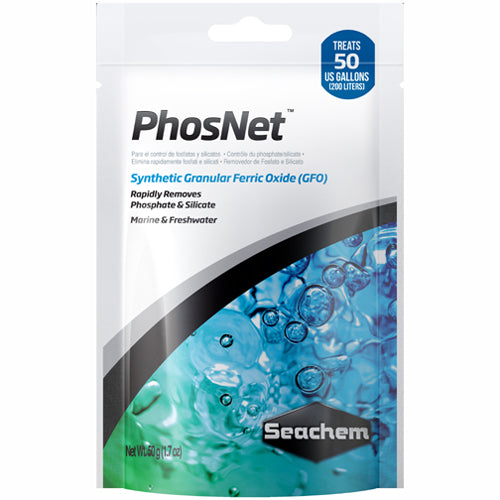
Seachem PhosNet - 50 g bagged
Seachem PhosNet - 50 g bagged
Low stock: 10 left
Couldn't load pickup availability
Our Live Arrival GuaranteeWe stand behind the health and quality of everything we ship.All items are WYSIWYG (What You See Is What You Get) unless otherwise noted. Every coral is carefully maintained and photographed under Reef Breeder Meridian LEDs so you can buy with confidence, knowing exactly what you’re receiving.
Product Detail
Product Detail
PhosNet
Product Description
PhosNet is a granular ferric oxide (GFO) with high porosity, high surface area and high binding capacity. It will rapidly remove phosphates and silicates from both freshwater and saltwater and will not release them back into your aquarium. It exhibits stronger binding than most competing products and consequently can reduce phosphates and silicates to very low levels. PhosNet also offers less dust and thus is easier to use than most competing GFO products.
Comparing Seachem Phosphate Removers
PO4 bound (mg/g)
PhosGuard (Alumina Oxide) 0.87
PhosBond (GFO and Alumina Oxide hybrid) 1.19
PhosNet (GFO) 1.41
aquavitro phosfiltrum (GFO) 1.71
Directions
For best results, PhosNetâ„¢ should be rinsed before use and placed so as to maximize the flow of water through it but not so that it tumbles against itself in flow. It may be used in a canister filter, media chamber, box filter, or any high flow area of a trickle filter. Use of a filter bag is recommended.
Use 50 g (½ cup) for every 200 L (50 US gallons) saltwater or 400 L (100 US gallons) freshwater. Leave product in place for 4 days, then test phosphate or silicate concentrations with either MultiTest Phosphate or MultiTest Silicate. If the concentration of the component you are trying to decrease has not dropped to around 0.02 mg/L, then replace the PhosNet, otherwise leave in place until levels begin to climb again. As long as concentrations remain under control, the product is not exhausted. Over treating is not recommended. PhosNet is not an exchange resin and does not release anything into the water. It does not leach phosphate or silicate back into the water and may be removed, dried, and returned to service until exhausted. Continuous use of small quantities is better than intermittent use of larger quantities.
ALSO ADD:

A20025 Aqua Ultraviolet 25 Watt Replacement Bulb
Price: $68.79

Simplicity 120 DC Skimmer in SUMP with DC pump
Price: $259.95